Whooo Arrre Youu???
 Being willing to question is good. It is often thought that going against foundations is a rebellion to be avoided, that straying from what you have been taught is a path that leads to danger. Christians often associate the fall of man with questioning God and eating the forbidden fruit. It is a misconception to believe that God doesn’t want you to ask why. Why is a good thing. It is usually what proceeds it or what accompanies the why that is the problem. As humans we are limited in our perspectives but we are also fallen and clouded in our every viewpoint. Our questions are often equipped with so much baggage, the answer is already predetermined in our minds. We are simply looking for a way to justify our position.
In fact God loves to disrupt our preconceived notions. It is only when our positions are shaken that we are able to hear His revelations of truth. We feel guilty questioning what comes natural to us, it goes contrary to all our instincts. This is exactly what He wants, for we can never trust in Him if we are trusting in ourselves. Sometimes this can be very confusing, because sometimes it is easy to confuse asking why with not trusting God. It is actually the opposite, trusting God to guide you and to reaffirm viewpoints helps us learn and grow closer to knowing God. Without repentance we are unable to believe. I am not referring to repentance as remorse or contrition, but as in changing one’s mind. If we are set in our views and trusting in what we see, we are willingly blocking what God reveals. We are unwittingly choosing not to believe.
There is actually only one sin that is unforgivable, and it is unbelief, or rejecting that Christ was the son of God, whose death and resurrection paid the full penalty for our sins so they we may have eternal life. Of course it is easy to see how a person that rejects God because of the shame of exposure makes bad decisions where the consequences lead to a spiraling effect that condemnation. It is more difficult to see how a person can be trapped in unfolding effects of good decisions. This person is walking by sight and not by faith exactly the same as the person who falls in the stereotypical lost category. Satan is the Prince of this world, and his realm is the temporal. When we walk by sight, all of our actions are building a sequence that solidifies unbelief, and firmly plants us in this world under his rule.
God’s most distinct quality is His holiness, this means He is unequal to anything else, He is set apart in every way. He would also like us to manifest this quality by setting ourselves apart from the temporal world. This doesn’t mean living in an arrogant bubble, but rather to avoid trusting in what we see. As we have said this is difficult because it our nature and our instinct, so to do this we must deny ourselves, and put our trust completely in Him. Walking by faith is a constant effort. We may attempt to use this faith as a foundation and settle back into our own perspectives. We need to be disrupted constantly so we are able to look to Him and not fall back on ourselves. This is why people hate to hear the truth, it convicts us. This why the controversial parts cannot be left out, we need to be convicted. God knows we will never see our need for Him if we are not knocked off of our foundation first. We will fail many, many times, but it is that initial trust, that first time we let go of our foundation and let Him replace it with His truth that changed our fate from the temporal to the eternal, from death to life, from the bonds of time to the freedom of eternity.
It is strange how much that Satan loves to mimic God. Dialectic thought that is so prevalent in this world is an imitation of Gods way of leading people to truth. I suppose that is why it is so brilliant and seemingly effective. Deriving order out of chaos makes use of a destabilized situation and uproots old ideas leaving a space for new ideas to be molded. The Marxist mentality is a cheap copy of Gods providence throughout history. Again we go back to the foundation of the idea. It is not change itself that is good any more than asking questions is bad. Faith is only as good as the object it is placed in, it really is what you believe in that is important not just the act of believing It happens that Gods attributes are absolute and eternal, and the changes promoted through the ideas in this world, the things seen, are only temporal. So simply put, putting our faith in this world, or ourselves, or anything in this universe, is something that will eventually fail no matter what, so it’s only hope is finding purpose in change itself. This is sold to us as growth or progress, and it’s ugliness is called duality.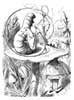
I used to believe in balance. Duality made sense to me. I grew up fond of Alice in Wonderland, the absurd logic that also seemed very practical was attractive. I loved the questions it proposed, my favorite was when the caterpillar asked, “who are you?” To me this question spoke volumes, it was inevitably unanswerable and dismissed as irrelevant, but it pulled me to the bigger question of, “What is the purpose for anything? ” It seemed to call attention to the contradictions in all thought. This spiral effect of circular reasoning was very intriguing. It was this, “what’s the point?” that eventually opened the door to finding the true purpose in all things, which cannot exist without God. See all unbelief contradicts itself, it is dualism by nature. I now have learned that Alice in Wonderland is just a glorification of that dualism, and probably a lot of other esoteric things and should probably be avoided. However, I still like the way it gives itself away. I go back to the beginning and say, it is good to ask why. It is not bad to be curious. It goes both ways, asking why is the only way to find truth, but you have to be willing to believe a new perspective and one that probably is not the same as your own, but most importantly, you must consider your source. When Adam and Eve ate the forbidden fruit they did not fall because they dared to ask a question, Man fell because his heart filled with unbelief and instead of asking God why, He trusted in himself.
 The Rabbit Hole
The Overman
Waking up, to a world with no meaning.
We live in the great nothingness.
Ideas have consequences.
Super heroes have developed as the ultimate expression of transcending the boundaries of society. We love the idea of being free to fly above the masses while having the ability to make the world a better place. Our culture reflects our belief that we can choose our own reality. The temporal realm is kept at a surface level of understanding and it’s our interpretations of that reality that is nurtured. We are led to create a world where our feelings and experiences are key. Whether we lock ourselves in a repetitive cycle like Momento or Inception, take our blue pill, or our soma, we are encouraged to escape the truth. We are attracted to the ideas of individual freedom and non-conformity, but without a transcendental source of truth we become fragmented into an existential darkness and an ultimate state of apathy. Our world has erased all absolutes and therefore we choose to dwell in individual bubbles of distraction, finding short-lived temporal comfort in our fragmented state of purposelessness. This has created an overall society of individual perspectives that are so apathetically detached, the only possible eventuality is a tyrannical police state. Of course, as in A Brave New World, our sense of purpose will be so far removed we will likely embrace the tyranny as if we could be bothered to engage long enough to even notice.
This cycle will result in the snake eating his tail scenario. Ironically our longing for individual freedom leads to its own demise. In our quest to break free from the bonds of society, we get lost in trying to secure our own imaginative state of autonomy. Then we willingly relinquish our freedom for dependency. Like Batman, feeding the Joker’s psychosis, we create our own monsters. We sow the seeds of our own destruction. We willingly blur the lines of truth to justify our emotional reality. We feed the hatred, play both sides, so in the end we are not even sure which side was which. This false confidence we look for within ourselves, trusting our own constructs, has a cyclical nature, but also leads to a linear progression in the pschycosphere.
From romanticism, to transcendentalism, existentialism, and finally the ultimate nihilism we have today, authors like Faust, Emerson, and Nietzsche, have been systematically deconstructing our reality for centuries. They have all contributed to the ideal image of the “overman” or “ubermensch” that became our “Superman” that we now hold dear. Sadly though, instead of a the moral and just hero we associate with Superman, we are really being prepared for the coming anti-Christ. Hitler used the idea of the overman to justify killing millions of Jews, we use it to justify post modernism.
We have gone from reason to non-reason. The French Revolution, communism, Nazi Germany, and the war on terror, all show us how idealism fails to translate to reality in an ever increasingly relativistic society. The most deadly century in history is our result.
It’s no wonder that Carl Jung’s solution of escaping reality to find the god within ourselves is the epitome our culture’s inability to live in and comprehend the real world. We are ill-equipped to deal the potential threats and convoluted entanglement of consequences that will come from our detached reality, whether we are warding off real and imaginary crime villains, or trying to deal with our own everyday hum drum problems and commitments.
Share this: