The Rabbit Hole

Curiouser and Curiouser!

Archive for the tag “theology”

The Overman

image

Waking up, to a world with no meaning.

We live in the great nothingness.

Ideas have consequences.

Super heroes have developed as the ultimate expression of transcending the boundaries of society.  We love the idea of being free to fly above the masses while having the ability to make the world a better place. Our culture reflects our belief that we can choose our own reality. The temporal realm is kept at a surface level of understanding and it’s our interpretations of that reality that is nurtured.  We are led to create a world where our feelings and experiences are key. Whether we lock ourselves in a repetitive cycle like Momento or Inception, take our blue pill, or our soma, we are encouraged to escape the truth.  We are attracted to the ideas of individual freedom and non-conformity, but without a transcendental source of truth we become fragmented into an existential darkness and an ultimate state of apathy.  Our world has erased all absolutes and therefore we choose to dwell in individual bubbles of distraction, finding short-lived temporal comfort in our fragmented state of purposelessness.  This has created an overall society of individual perspectives that are so apathetically detached, the only possible eventuality is a tyrannical police state.  Of course, as in A Brave New World, our sense of purpose will be so far removed we will likely embrace the tyranny as if we could be bothered to engage long enough to even notice.

 This cycle will result in the snake eating his tail scenario.  Ironically our longing for individual freedom leads to its own demise.  In our quest to break free from the bonds of society, we get lost in trying to secure our own imaginative state of autonomy. Then we willingly relinquish our freedom for dependency.  Like Batman, feeding the Joker’s psychosis,  we create our own monsters. We sow the seeds of our own destruction. We willingly blur the lines of truth to justify our emotional reality.  We feed the hatred, play both sides, so in the end we are not even sure which side was which. This false confidence we look for within ourselves, trusting our own constructs, has a cyclical nature, but also leads to a linear progression in the pschycosphere.

From romanticism, to transcendentalism, existentialism, and finally the ultimate nihilism we have today, authors like Faust, Emerson, and Nietzsche, have been systematically deconstructing our reality for centuries. They have all contributed to the ideal image of the “overman” or “ubermensch” that became our “Superman” that we now hold dear. Sadly though, instead of a the moral and just hero we associate with Superman, we are really being prepared for the coming anti-Christ. Hitler used the idea of the overman to justify killing millions of Jews, we use it to justify post modernism.

We have gone from reason to non-reason. The French Revolution, communism, Nazi Germany, and the war on terror, all show us how idealism fails to translate to reality in an ever increasingly relativistic society. The most deadly century in history is our result.

It’s no wonder that Carl Jung’s solution of escaping reality to find the god within ourselves is the epitome our culture’s inability to live in and comprehend the real world. We are ill-equipped to deal the potential threats and convoluted entanglement of consequences that will come from our detached reality, whether we are warding off real and imaginary crime villains, or trying to deal with our own everyday hum drum problems and commitments.

girl_floating_on_water_thumb

Where are the words that fill my brain?

The words that lurk unformed, peeping out in blurry bits.

Words to pick apart the blanket of silence crushing down,

Isolating, defeating, smothering.

Words to lift me out of my island to myself,

Words to travel the vast empty space.

To cast out, to catch the hope,

to latch on to living souls.

The souls are sleeping, the words are afraid to wake them up.

The space is growing, swallowing letters, leaving vapors.

The silence is up to my ears now, distorting the distant sounds,

with cool lapping to and fro, the words floating away,  a distant sailboat

as it disappears with the sun.

Time in a Bottle

11870857_10207914412367827_8536712931395009750_n

My story begins sometime when I was about 12 years old.  I had my own space in our new house, and lots of it.  A hidden door in my closet opened to an attic I had claimed as my secret room. I covered the walls with song lyrics and would bury myself in blankets in the winter, and sweat to death in the summer, while I spent hours upon hours in my little bunker, writing poems, painting, and listening to music. The occasional spider or spooky shadow sometimes sent me bolting out into the closet like the kids from Narnia trying to find their way home.

On a clear summer night, I would sit outside my window on the roof, and stare at the stars.  I had it in my head that I was in love with some boy from school. I never talked to him, and didn’t really know much about him, but I had this idea about love. It was self-sacrificing and deep. I didn’t care if he ever talked to me again, but I would daydream about him growing up, getting married and being happy. I would sit on my little roof and wish to the stars,  and whisper, “I love you, I love you, I love you.” Something about threes was important. Say it three times, I am not sure why. I think I had some sense of triunity, I knew that the threes held everything together.

Behind my parents house, there was a heavily treed creek, and further back, a small pond. I loved it back there. After school, I would lay and read on this huge fallen tree that made a bridge across the creek. My dad was sure I had taken all the kitchen spoons somewhere in those woods. Some days, I hiked back to the pond, through the thick brush. I distinctly remember, on many a brisk fall evening, realizing I had missed the straight path and was caught in the middle of the thorn trees, and nettles, and spider webs, right when dusk was setting in. Panic crept up as the wind carved through my clothes. There was never a good way out, I would wish I could teleport myself. Trying not to think about what was stirring in the waist-high grass, I would just starting running like a maniac in full panic mode. I generally emerged with a few bloody scratches and the cursed nettles stinging like hell. My mom’s voice in my heading saying, “I am NOT buying you any more shoes!” But as I climbed up to the bank to the pond, the sun scattered all over the surface of the water, blinking like diamonds, and the sky a million shades of pink and purple, my recent trauma would melt away, forgotten, and I would say,”I love you, I love you, I love you.”

I loved that pond so much, I used to tell people I wanted my ashes scattered there when I died. Well, a third of them, I wanted a third in the ocean, and a third in the mountains somewhere. You know, threes. I used to think about death a lot, not in a morbid way, just in a matter of fact kind of way.  I never really felt like I was part of this world. I never pictured myself growing up and doing all the traditional things people do. I would tell people, I was going to grow up and live on the beach in a VW bus, yep, I was going to be a bag lady and sell sea shells by the sea-shore. Until I was 19 of course, after that, I would most likely be dead.  Just couldn’t picture living past 20. I would also plan that for some reason I was living past 20, I would just live vicariously through my best friend’s life, I would be her nanny and help raise her children, and love them as my own. Strange how things turn out.

I thought this through high school, so it didn’t bother me at all when I left my sophomore year and took my equivalency test to start classes at the community college.  I didn’t mind missing prom and graduation, or the college experience, I just never expected to do those things anyway.

When I did eventually grow older than 19, my thinking did not really change. I got married about a month after my 22 birthday.  I didn’t think about it ahead of time, we had known each other only a few months and decided to elope one weekend without telling anyone. I never thought I would get married.  I got pregnant within a few months after that, and I just kept moving forward. I never thought I would have kids. Of course I was happy though, I loved my family, and I was grateful for my life.  I just never expected it to happen that way.

For the next several years I was just busy just living, and I didn’t have a chance to think too much. Always in the back of my mind, though, I would still look at the stars and think, “I love you, I love you, I love you.” Somewhere along my path, all the questions that I had been pushing down over the years, came popping up, like that little squirrel in Ice Age trying to plug all the holes. Maybe the cliché’ questions like, “Why am I here?” were a bit of a stretch, but I knew there was so much more than I could see. I had always felt like a vessel passing through, my soul watching out the window, trees and people whizzing by. Buildings and landscape until it just fades into a blur. Time and space ticking along, suppressing the eternity trapped inside.

You see, that’s what it is, God put eternity in all our hearts, and we go through life pushing it down, or trying to turn it into something else. We have eternity in our hearts because we are made in Gods image.  Because he is eternal, we have a sense of eternity, an internal understanding. Yet we toil away in time, trying to hold on to what is already passing away.

We all know God. Not just an idea of a god, something that connects us all,  or some sort of cosmic designer.  We know HIM. Personally.

For since the creation of the world His invisible attributes, His eternal power and divine nature, have been clearly seen, being understood through what is made, so that we are without excuse. Romans 1:20

Obviously, we are born and begin at a given time, but God is eternal and has known us throughout eternity. He has always known outside time everything He would ever carry out inside time. He is in control of every aspect of time and space. We sometimes like to think of the universe as eternal. The universe cannot be eternal because it was created by God, and if it were not, there could be no purpose to anything. Something that’s eternal could not be designed because it would precede any designer, so that would make the universe and everything in it, right down to every subatomic quark, completely random and without purpose. So either you have random eternal matter, or an eternal designer , and that would, therefore, give everything in the universe purpose.

God tells us that the day will come when nothing we see will exist. He will put an end to time and space as we know it. Even death itself. Up to this point we have a choice, it’s simple really. Do we want life or death? There is only one source of life. God offers us eternity, as a free gift. Yet, sadly, we often choose darkness over light. We choose death.

And the sea gave up the dead which were in it, and death and Hades gave up the dead which were in them; and they were judged, every one of them according to their deeds. Then death and Hades were thrown into the lake of fire. This is the second death, the lake of fire. And if anyone’s name was not found written in the book of life, he was thrown into the lake of fire. Rev 20:13-15 Then I saw a new heaven and new earth, for the first heaven and the first earth passed away, and there is no longer any sea. Rev. 21:1


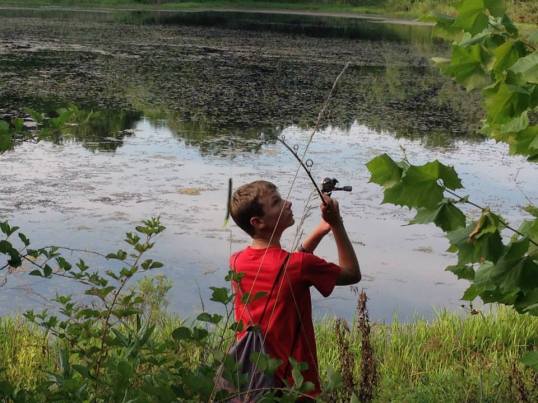
Last summer I was visiting my parents, and I again hiked back to the pond. My son and I braved the nettles and thorn trees with panic at dusk.  The sunlight greeted us as we climbed the bank. Of course, time had moved on, the water was covered in moss and the overgrowth was so thick we could not get too close to the water. That’s the trouble with time, it keeps going. We look to the future with hope and faith, and to the past with judgement and regret. Trying to make our way to the things we want to find, but hold on to the things we lost, but we only grasp at dust.

In eternity, there will be no judgement, no hope or faith, for all is realized and we will see as we are meant to see. No more glimpses of what is to come, no more regret for things past. But, what remains forever will be the most important thing, LOVE.

For now we see in a mirror dimly, but then face to face; now I know in part, but then I will know fully just as I also have been fully known. But now faith, hope, love, abide these three; but the greatest of these is love. 1 Corinthians 13:12-13

I know that this is what I want to cling to, that is why I am here on this planet. I know as I pass through in my vessel, those sparkles on the pond’s surface, and far up in the night sky, those people I meet along the way, my family, and my babies I hold tight, these are  glimpses into eternity. This is where my heart lives. I cannot hold on to anything in this world, but I will listen to Him as He calls me from eternity, as I have heard Him since I was young, and I will answer Him back from time, “I love you, I love you, I love you.”

Circular Reasoning and the Beauty of Balance

Isn’t funny how our brains can migrate from a glimpse of absolute clarity to complete vacancy in what seems like a nano second?  How does that happen?  Thoughts go from conceptualizations to vapors before they are made into actual thoughts, much less words.  I really hate that.  It is sort of my version of circular reasoning, of the unintelligent kind.  I go from nothing back to nothing.  Of course it is hard work getting there too!  It reminds me of Vizzini from the Princess Bride trying to rationalize which cup has the poison.

I believe these glimpses or fragments are finite versions of some sort of whole.  We spend our lives trying to replicate this whole in one way or another. We often reason ourselves from one side of an issue to another, trying to find it’s truth, trying to find it’s purpose.  It is an endless quest of futility. We search to find balance or unity through the many paradoxes we encounter everyday.  Sometimes, we even try to understand the greater why that fuels them all. We try, but we are just finite beings, we are just grasping at fragments. There can never be purpose or understanding if all we have is a part of a whole. We may try to figure out the whole, the “one” that unites all these parts. Perhaps with the proper logic or experience we can fill in the blanks.

What was the whole again? What were we talking about?

Oh, right, there I go again.

We assume the whole is just everyone’s fragments. Naturally, right?  All the bits and pieces of everything, the ideas and experiences, matter and energy all rolled into one.

I don’t think so. I mean, I am sure they make up some sort of whole. I just don’t think they are the whole we are looking for. They are our counterfeit whole. In their grand sum they are still just fragments, just parts.  There is nothing to tie them together and give them unity. So if that is true, then there is no purpose to anything.  We can find only temporary meaning or purpose, but no real truth, nothing eternal.

What if all that energy and matter and bits and pieces, all those rabbit trails of fragmented reasoning are really a reflection of something bigger? A reflection of the real whole? Something outside of all of those things. Something where each of those fragments represent an entire whole? What if all of those parts are actually given purpose by the whole, the “One” that creates union and balance? If that is true, if things can have balance and purpose, and they must have been designed that way. If not, we go back to our random parts, back to our meaningless fragments.

Many attribute this design to some unseen force or power in the universe.  They think that somehow all the molecular structure of everything is connected and works together to guide and unify.  I suppose that makes sense in a way. Everything consists of the same elements, things do connect in many ways.  There is something missing though.  The universe may be a natural leap because it is seemingly infinite and the largest thing we can attempt to fathom.  While the universe is indeed large, it cannot compare to the intricate vast depth of a conscious being.  It is not capable of logic or reasoning, it has no nature or personality.  So it becomes impossible to connect the randomness of a universe of matter, space and energy with the abstract world of a conscientious personality.  Even if you could somehow combine both realms into one reality, you would still be left with an incomplete whole.  There is nothing to connect the physical and spiritual world together to give it meaning.  We can only wonder from one side to the other as the emptiness of one side fuels the other.

So one can either bounce along this path indefinitely, or reach the end of their existential rope.  Either way, they are powerless and left with vapors.

So maybe those fleeting moments of clarity are just electromagnetic impulses in our brains.  Or perhaps they are a glimpse of something more.  I believe they are both, I believe both have purpose.  However, the only possible way for both to exist with purpose is if what unifies them is eternal.  Eternal in all ways.  Eternal in space, omnipresent. Eternal in consciousness, omniscient.  Infinite, or outside time, and sovereign in all ways.  There is nothing like that in our universe or even in the depths of our imagination, nothing at all for comparison.  Anything we use to try to represent this, no matter how large, is temporal.

Yet somehow we all innately know the only thing to describe this is God.  He must contain all of these attributes, and what we see both within the physical universe and within our abstract minds are finite versions of His infinite attributes.  They all reveal Him, and Him as their creator.  This is why He can be the only answer, the meaning to all things.  The beginning and end to all reasoning.  The difference between endless circular reasoning, and a beautiful balance and unity in all things.

Whooo Arrre Youu???

dsc00872.jpg    Being willing to question is good.  It is often thought that going against foundations is a rebellion to be avoided, that straying from what you have been taught is a path that     leads to danger.  Christians often associate the fall of man with questioning God and eating the forbidden fruit.  It is a misconception to believe that God doesn’t want you to ask why.  Why is a good thing.  It is usually what proceeds it or what accompanies the why that is the problem.  As humans we are limited in our perspectives but we are also fallen and clouded in our every viewpoint.  Our questions are often equipped with so much baggage, the answer is already predetermined in our minds.   We are simply looking for a way to justify our position.
In fact God loves to disrupt our preconceived notions.  It is only when our positions are shaken that we are able to hear His revelations of truth.  We feel guilty questioning what comes natural to us, it goes contrary to all our instincts.  This is exactly what He wants, for we can never trust in Him if we are trusting in ourselves.  Sometimes this can be very confusing, because sometimes it is easy to confuse asking why with not trusting God.  It is actually the opposite, trusting God to guide you and to reaffirm viewpoints helps us learn and grow closer to knowing God.  Without repentance we are unable to believe.  I am not  referring to repentance as remorse or contrition, but as in changing one’s mind.  If we are set in our views and trusting in what we see, we are willingly blocking what God reveals.  We are unwittingly choosing not to believe.

There is actually only one sin that is unforgivable, and it is unbelief, or rejecting that Christ was the son of God, whose death and resurrection paid the full penalty for our sins so they we may have eternal life.  Of course it is easy to see how a person that rejects God because of the shame of exposure makes bad decisions where the consequences lead to a spiraling effect that condemnation.  It is more difficult to see how a person can be trapped in unfolding effects of good decisions.  This person is walking by sight and not by faith exactly the same as the person who falls in the stereotypical lost category.  Satan is the Prince of this world, and his realm is the temporal.  When we walk by sight, all of our actions are building a sequence that solidifies unbelief, and firmly plants us in this world under his rule.

God’s most distinct quality is His holiness, this means He is unequal to anything else, He is set apart in every way.  He would also like us to manifest this quality by setting ourselves apart from the temporal world.  This doesn’t mean living in an arrogant bubble, but rather to avoid trusting in what we see.  As we have said this is difficult because it our nature and our instinct, so to do this we must deny ourselves, and put our trust completely in Him.  Walking by faith is a constant effort.  We may attempt to use this faith as a foundation and settle back into our own perspectives.  We need to be disrupted constantly so we are able to look to Him and not fall back on ourselves.  This is why people hate to hear the truth, it convicts us.  This why the controversial parts cannot be left out, we need to be convicted.  God knows we will never see our need for Him if we are not knocked off of our foundation first.  We will fail many, many times, but it is that initial trust, that first time we let go of our foundation and let Him replace it with His truth that changed our fate from the temporal to the eternal, from death to life, from the bonds of time to the freedom of eternity.

It is strange how much that Satan loves to mimic God.  Dialectic thought that is so prevalent in this world is an imitation of Gods way of leading people to truth.  I suppose that is why it is so brilliant and seemingly effective.  Deriving order out of chaos makes use of a destabilized situation and uproots old ideas leaving a space for new ideas to be  molded.  The Marxist mentality is a cheap copy of Gods providence throughout history.  Again we go back to the foundation of the idea.  It is not change itself that is good any more than asking questions is bad.  Faith is only as good as the object it is placed in, it really is what you believe in that is important not just the act of believing   It happens that Gods attributes are absolute and eternal, and the changes promoted through the ideas in this world, the things seen, are only temporal.  So simply put, putting our faith in this world, or ourselves, or anything in this universe, is something that will eventually fail no matter what, so it’s only hope is finding purpose in change itself.  This is sold to us as growth or progress, and it’s ugliness is called duality.caterpillar

I used to believe in balance. Duality made sense to me.   I grew up fond of Alice in Wonderland, the absurd logic that also seemed very practical was attractive.  I loved the questions it proposed, my favorite was when the caterpillar asked, “who are you?”  To me this question spoke volumes, it was inevitably unanswerable and dismissed as irrelevant, but it pulled me to the bigger question of, “What is the purpose for anything? ”  It seemed to call attention to the contradictions in all thought.  This spiral effect of circular reasoning was very intriguing.  It was this, “what’s the point?” that eventually opened the door to finding the true purpose in all things, which cannot exist without God.  See all unbelief contradicts itself, it is dualism by nature.  I now have learned that Alice in Wonderland is just a glorification of that dualism, and probably a lot of other esoteric things and should probably be avoided.  However, I still like the way it gives itself away.  I go back to the beginning and say, it is good to ask why.  It is not bad to be curious. It goes both ways, asking why is the only way to find truth, but you have to be willing to believe a new perspective and one that probably is not the same as your own, but most importantly, you must consider your source.  When Adam and Eve ate the forbidden fruit they did not fall because they dared to ask a question, Man fell because his heart filled with unbelief and instead of asking God why, He trusted in himself.

The Price of Liberty

How do we place a value on life?  I recently saw a video of a little girl in China that was run over and left bleeding in the street.  People were walking around her like a piece of trash and then she was run over a second time before someone pulled her broken body out of the street.  It’s hard to imagine living in a society where that is possible.  We never think that we could be numb to someone else’s suffering, that we have some sense of humanity that protects us from cruelty.  The truth is history has us shown differently.  We can be influenced by society and fear of consequence and general persuasion can lead us to condition ourselves to become accustomed to all kinds of atrocity.  In Nazi Germany, by the time anyone felt the problem was serious enough to speak up, the consequences were so severe they kept any protests quiet.  Within the past century our own country has stood by and watched racial hatred as if it were normal behavior.   During the Civil War we had a country split in half over whether or not people should have the freedom to own slaves.  Many things that we now see as absolutely horrific have been viewed as normal or even majority view at some point in time.

Societies have always struggled with the emphasis of the importance of the individual versus the good of the whole.  We all can agree that a society needs structure and order to keep life from being complete chaos, but should it be as the cost of personal freedom?  The problem is the value of life will decline at either end of the spectrum.  If personal freedom prevails, then what is to stop a person from exploiting others for their own gain?  Child labor, slavery, domestic abuse, the way workers were treated during the industrial revolution are a few examples of how individual liberty can lead to declines in society.  However if the pendulum swings in the other direction we can end up with tyranny and oppression, genocide, fear and complacency, where people look aside when they see suffering.   Again if the pendulum swings to the side of personal freedom, the value of liberty can prevail against the value of human life and lead to rationalizing issues like mercy killing, euthenasia or abortion, after all, people are just exercising their personal freedom right?  Who are we to tell them they are wrong?  This is why it is sometimes difficult to see the difference between far right and far left, you usually end up in the same place.  Fascism and communism have many similarities.

So what are we left with?  Either extreme leads to relativism and a devaluing of life.  As important as freedom and democratic ideals are, they are really more of a result than something you can strive for.  Society often tries to model itself after other successful societies throughout history only to fall miserably off track.  Liberty itself can mean different things to different people, and can become a complete farce if imposed upon a society without the morality to uphold its value.  We associate democracy with ancient Greece, but as Plato said, “Democracy leads to despotism.”  His view was people’s freedom should be based on their voluntary submission to the elite representatives that composed their laws and represented their culture and ultimately defined their truth.  So a person could achieve personal freedom as long as they were able to redefine their definition of what that meant.

The liberty that we idealise today generally assumes morality is intrinsic within the individual, that given the right environment, personal conscience would prevail.  This is a logical assumption when we look back upon times in our history when personal freedom was paramount, but the conditions that led to liberty must be understood to see how it was achieved.  We take advantage of the morality we have been taught in that we don’t see how it colors our decisions and the consequences of our ideas.  Our American culture is fortunate to have a history and constitution that instills value for human life, and personal freedom in that our system of justice defers to a higher law.  The Beauty of this higher law is partly derived from the ten commandments.  In fact we have them printed on the doors of our Supreme court.  They are usually taken for granted, simplified or considered outdated.  However if we listen to the wisdom behind these ten simple laws we can unlock the key to a successful society.  The commandments have a chiastic structure that unifies the importance of all of them to a single element, the value of life.

For a society to be successful in longevity certain elements must be protected, labor and property, marriage and family, and truth.  There is a commonality in the third and ninth commandment,  Thou shalt not take the Lord’s name in vain and Thou shalt not bear false witness against thy neighbor.  Both protect truth.  If we start calling God what he is not, or using God’s name with a different meaning or intention it is the beginning of redefining truth.  This is important because if language is not protected and words begin to mean whatever we want them to mean, they become corruption and truth becomes relative.  Bearing false witness against your neighbor is an obvious example of this corruption.  The fourth and eighth also relate, Thou shall respect the sabbath and keep it holy and Thou shalt not steal.  On the sabbath not only were the Israelites supposed to rest, but their animals, their labourers and also their land.  Every component of a person’s property was to be respected and held in high regard.  Thou shall not steal is another example of how property and ownership was to be respected.  Another connection lies between the fifth and seventh commandment, Thou shalt honor thy father and mother and Thou shalt not commit adultery.  These both protected the family structure.  Family is what society is based on, they are the first small businesses as well.  They are the backbone of education and economy and when families fall apart, everything falls apart.  Finally respecting our elders leads to and ties in the ultimate commandment, Thou shalt not murder.  A respect and value for life is the cornerstone for all morality that a society should be based on.

However none of these can be possible without the second and tenth commandment,  Thou shall have no other gods before me and Thou shall not covet.  These cannot be judged or dictated by society and this is the foundation that makes liberty possible.  These are what brings forth freedom.   These are commandments of the heart.  We cannot measure them by actions and if they are not there or insincere the rest will fall apart.  Having no other gods before Him, means putting God first, ahead of yourself.  That means a lot more than most people think it means and it is that humility that allows a person to sacrifice their own gain to respect others.  Thou shall not covet means more than not wanting a house or a wife like your neighbor, or simple jealousy.  It means being content with what you are given.  Having a thankful heart for everything God sends your way.  That means every time we complain or grumble, or long for a situation to change, we are coveting.  These commandments are difficult and some would say downright impossible, and ultimately they can only come from God’s grace, but they can be the wisdom we look to when the pendulum swings.

Post Navigation